
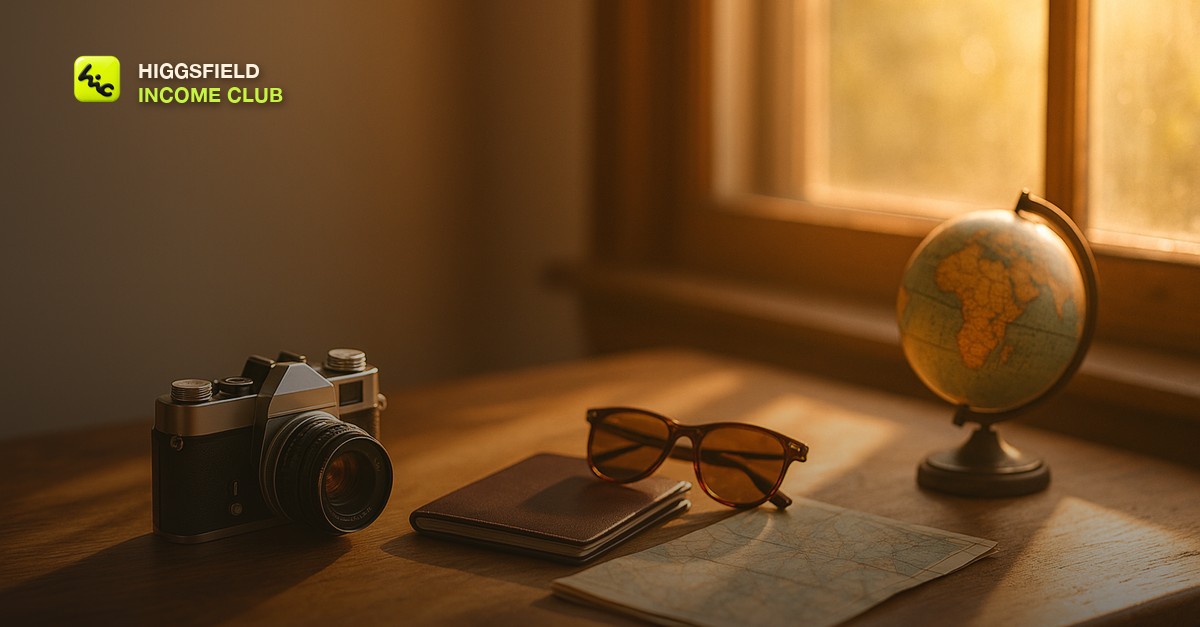
Why travel is a perfect AI video niche
Learning how to make AI travel videos solves the most expensive problem in the travel content business: being there. Traditional travel footage requires flights, permits, weather luck, and drone hardware. With Higgsfield you can generate a lantern-lit alley in a rain-washed old town, a slow aerial drift over turquoise coastline, or a misty mountain pass at dawn from your desk. That collapses the cost of the most visually demanded content category on every platform to the price of your generation credits.
It is also a natural fit for the faceless model. Travel audiences come for the place, not the presenter, so a channel built from destination footage, ambient sound, and a calm voiceover needs no on-camera personality at all - the structure in [how to start a faceless AI video channel](/blog/how-to-start-a-faceless-ai-video-channel) maps onto travel one-to-one. The one non-negotiable: be honest that the footage is AI-generated. Passing synthetic footage off as a real place you filmed is how channels burn trust and run into platform policy, and the full reasoning is in [do you have to disclose AI-generated video](/blog/do-you-have-to-disclose-ai-generated-video).
The Postcard Method: one destination, one light, one move
The Postcard Method is the club's framework for travel clips, and it exists because the default failure mode of AI travel video is the blender montage: five landmarks, three light conditions, and a hyperactive camera in one clip, none of it registering. A postcard works because it commits - one place, one moment of light, one composition. Your clips should do the same: pick a single destination scene, a single light condition, and a single slow camera move, and let the atmosphere carry the clip.
The Postcard Method per clip
| Element | Commit to one | Example |
|---|---|---|
| Destination scene | One specific place, not a city tour | A narrow canal at the edge of an old town, laundry lines overhead |
| Light condition | One time of day and weather | Golden hour after rain, wet cobblestones reflecting the sky |
| Camera move | One slow move that suits the space | A gentle forward drift at walking height, or a slow aerial pull-back |
Prompt structure follows the same order: place first, light second, texture and atmosphere third, camera last. The difference between screensaver footage and cinematic footage is specificity - 'a beautiful beach at sunset' produces a stock cliché, while 'a black-sand cove under low silver clouds, sea mist drifting across basalt rocks, slow push toward the waterline' produces a place. The lighting vocabulary that does the heavy lifting is covered in [how to get cinematic lighting in AI video](/blog/how-to-get-cinematic-lighting-in-ai-video), and the camera language in [how to control camera motion in AI video](/blog/how-to-control-camera-motion-in-ai-video) - travel is where both skills pay the most.
For longer pieces - a destination film rather than a single reel - generate a sequence of postcards of the same place across a day: dawn mist, midday market color, dusk lanterns, night rain. Same location vocabulary in every prompt, different light per clip, and the sequence cuts together as a journey. Stitching those clips into a longer edit without the seams showing is the craft in [how to make AI videos longer than the clip limit](/blog/how-to-make-ai-videos-longer-than-the-clip-limit), and sound carries half the illusion - layered ambience and distant city noise per [sound design for AI-generated videos](/blog/sound-design-for-ai-generated-videos) makes a generated place feel inhabited.
Building a repeatable travel content system
One good travel clip is a fluke; a system is a channel. The move is to turn every prompt that produces a strong clip into a reusable scene formula - the destination vocabulary, the light recipe, the camera move - and file it, so next week's clip is a variation instead of a blank page. This is exactly the discipline from [build an AI video prompt library](/blog/build-an-ai-video-prompt-library), and travel is the niche where it compounds fastest because the formulas transfer: your 'rain-washed old town at dusk' recipe works for a dozen different imagined towns.
- Pick a lane: a region, a mood (rainy cities, remote coastlines, mountain silence), or a format (60-second destination postcards).
- Build three to five scene formulas in that lane and save them to your prompt library.
- Produce in batches - one generation session yields a week of postcards when the formulas already exist.
- Publish on a steady cadence and let the recommendation systems find your audience.
- Review what held attention, promote the winning formulas, retire the rest.
Three ways AI travel footage becomes income
The first lane is your own channels. Travel is an evergreen content appetite - destination reels, ambient 'walk with me' pieces, and rain-on-the-window mood films all hold attention, and a faceless travel channel monetizes through the standard stack of platform payouts, affiliate placements, and audience-funded products. The full conversion map is in [how to turn AI video views into monthly income](/blog/how-to-turn-ai-video-views-into-monthly-income).
The second lane is client work. Travel-adjacent businesses - tour operators, hotels, travel bloggers, booking-site affiliates - need mood footage constantly and cannot afford location shoots for every campaign. Stylized AI destination footage, clearly presented as AI, fills that gap at a price traditional production cannot touch, and the pitch mechanics are the same as any vertical in [how to get your first AI video client](/blog/how-to-get-your-first-ai-video-client). The third lane is licensing: strong atmospheric clips can be packaged and licensed as b-roll, and the mechanics and honest caveats are covered in [how to license AI video as stock footage](/blog/how-to-license-ai-video-as-stock-footage).
Inside the Higgsfield Income Club at higgsfieldincomeclub.com, $9/month, members share the travel scene formulas that are holding attention right now, which destination moods are working per platform, and how the faceless travel channels in the community actually structure their weeks. If travel is the niche that pulls you, start from formulas that already work instead of burning credits rediscovering them.
Short, practical drops on income paths, prompts that work, packaging for views, and getting paid. No spam, unsubscribe anytime.
Frequently asked questions
Can AI really make realistic travel videos?
Yes, with the right prompting. Commit each clip to one destination scene, one light condition, and one slow camera move - the Postcard Method - and prompt with specific light, weather, and texture details instead of generic descriptions. The result reads as cinematic and atmospheric. Stylized-beyond-real is the strength; present it honestly as AI rather than as documentary footage.
Do I have to say my travel videos are AI-generated?
You should, and on most platforms you are required to disclose realistic AI content via their built-in settings. Beyond policy, honesty is the better strategy: channels framed as 'destinations reimagined' build trust and lean into what AI does best, while fake geotags and pretend trips are a trust collapse waiting to happen.
What should I prompt for in an AI travel video?
Order the prompt as place, light, texture, camera. Name a specific scene rather than a city, one time of day and weather condition, the textures that sell realism - wet cobblestones, drifting mist, lantern glow - and finish with a single slow camera move. Specificity is the entire difference between screensaver footage and a place that feels real.
Can you make money with a faceless AI travel channel?
Travel is one of the stronger faceless niches because the audience comes for the place, not a presenter. Income comes from the standard faceless stack - platform monetization, affiliate placements, and your own products - plus two lanes unique to the niche: client footage for travel-adjacent businesses and licensing atmospheric clips as b-roll.
What is the Postcard Method?
It is the club's framework for travel clips: every clip commits to one destination scene, one light condition, and one slow camera move, like a postcard in motion. It exists to prevent the default failure mode of AI travel video - montages that cram five landmarks and a hyperactive camera into one clip where nothing registers.
Last reviewed by David on September 22, 2026